
Frosted circus animal cookies already have everything a fun cake needs: vanilla flavor, bright pink and white icing, and plenty of sprinkles. Turning them into a full Frosted Circus Animal Cookie Cake gives you that same nostalgic flavor in a soft, tall layer cake that still feels homemade rather than overly sweet.
This version starts with tender vanilla cake layers filled with crushed frosted animal cookies. The cookie pieces soften slightly as the cake bakes, leaving little pockets of vanilla-cookie flavor throughout each slice. A smooth vanilla buttercream goes between the layers, while part of the frosting gets tinted pink to match the classic cookies.
You do not need advanced decorating skills for this cake. The most important parts are measuring the batter evenly, letting the layers cool all the way, and keeping the frosting soft enough to spread without becoming runny. The decorating can stay playful and relaxed.
Time & Difficulty
What You Need
For the Cake
- 2½ cups all-purpose flour
- 2½ teaspoons baking powder
- ½ teaspoon fine salt
- ¾ cup unsalted butter, softened
- 1¾ cups granulated sugar
- 4 large eggs, room temperature
- 1 tablespoon vanilla extract
- 1 cup whole milk
- ½ cup sour cream
- 1½ cups crushed frosted circus animal cookies
For the Buttercream
- 1½ cups unsalted butter, softened
- 5 cups powdered sugar
- ⅓ cup heavy cream or whole milk
- 2 teaspoons vanilla extract
- Pinch of salt
- Pink gel food coloring
For Decorating
- Frosted circus animal cookies
- Rainbow nonpareils or confetti sprinkles
Equipment
- Three 8-inch round cake pans
- Parchment paper
- Large and medium mixing bowls
- Electric hand mixer or stand mixer
- Whisk
- Rubber spatula
- Measuring cups and spoons
- Cooling racks
- Offset spatula
- Serrated knife or cake leveler
At a Glance
- Preheat the oven and prepare the cake pans.
- Crush the frosted circus animal cookies.
- Whisk the dry ingredients together.
- Cream the butter and sugar until fluffy.
- Beat in the eggs and vanilla.
- Mix the dry ingredients and milk into the batter.
- Fold the crushed circus animal cookies into the batter.
- Divide the batter evenly between the pans.
- Bake the cake layers until set.
- Cool the cake layers completely.
- Beat the vanilla buttercream until smooth.
- Tint part of the frosting pink.
- Level the cooled cake layers.
- Fill and stack the cake layers.
- Apply a thin crumb coat.
- Chill the crumb-coated cake.
- Frost the Frosted Circus Animal Cookie Cake.
- Add sprinkles and circus animal cookies.
- Chill briefly before slicing.
Plan on about 3 hours total, including cooling and chilling time. Most of that is hands-off. Once the cake is stacked and covered with sprinkles and cookies, you will have a colorful celebration cake that works well for birthdays, parties, or anyone who still reaches for the circus animal cookies first.
Preheat the oven and prepare the cake pans
Heat the oven to 350°F (175°C). Grease three 8-inch round cake pans, then place a parchment-paper circle in the bottom of each pan. Lightly grease the parchment too. This extra layer matters because pieces of frosted cookie can stick more firmly than plain vanilla cake.
Try to use pans of the same size and depth. Matching pans help all three layers bake at nearly the same rate and make stacking much easier later.
Crush the frosted circus animal cookies
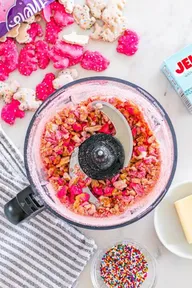
Place about 1½ cups of frosted circus animal cookies in a zip-top bag and press out the extra air. Break them into small pieces with a rolling pin or the flat bottom of a measuring cup.
Aim for pieces between coarse crumbs and pea size. Do not grind them into powder. A mix of small crumbs and visible cookie pieces gives the finished cake better texture and lets the pink-and-white cookie bits show inside each slice.
Whisk the dry ingredients together
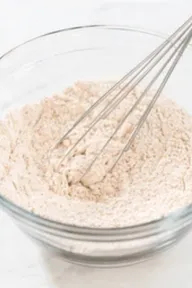
Add 2½ cups all-purpose flour, 2½ teaspoons baking powder, and ½ teaspoon fine salt to a medium bowl. Whisk for about 20 seconds, making sure the baking powder is spread evenly through the flour.
This short step prevents one part of the cake from getting too much leavening while another gets too little. Break apart any visible flour lumps with the whisk before setting the bowl beside your mixer. Keep the crushed cookies separate for now.
Cream the butter and sugar until fluffy
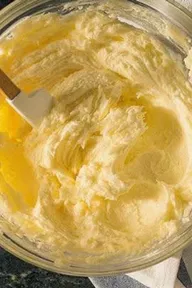
Beat ¾ cup softened unsalted butter with 1¾ cups granulated sugar on medium-high speed for about 3 to 4 minutes. The mixture should become pale, creamy, and noticeably lighter in texture.
Scrape the sides and bottom of the bowl once during mixing so no dense butter stays trapped underneath. Proper creaming creates tiny air pockets that help the cake rise with a soft crumb instead of baking up heavy.
Beat in the eggs and vanilla
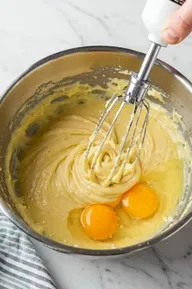
Add the 4 large eggs one at a time, beating for about 20 seconds after each addition. Scrape the bowl when needed so the mixture stays even.
Pour in 1 tablespoon vanilla extract and beat for another 15 seconds. The batter may look slightly separated after an egg goes in, especially if the ingredients are cold. Keep mixing until it comes back together. Room-temperature eggs blend into the butter mixture much more smoothly.
Mix the dry ingredients and milk into the batter
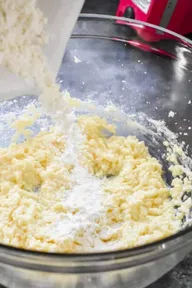
Whisk 1 cup whole milk with ½ cup sour cream in a small bowl. With the mixer on low speed, add about one-third of the flour mixture, followed by half of the milk mixture. Repeat, then finish with the remaining flour.
Pro Tip
Once the flour goes in, keep the mixer on low speed. Mixing for too long develops more gluten and can make the cake layers firm instead of soft and tender.
Fold the crushed circus animal cookies into the batter
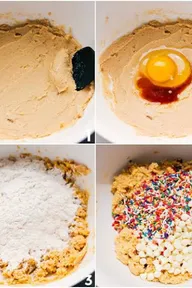
Add the 1½ cups crushed frosted circus animal cookies to the finished batter. Use a rubber spatula to fold them in with broad, gentle strokes until the pieces are spread throughout.
Stop once the cookie bits look evenly distributed. Overworking the batter at this stage can knock out some of the air you built during creaming. A few pink and white streaks from the cookie coating are fine and will give the baked layers that classic circus-cookie look.
Divide the batter evenly between the pans

Set the three prepared 8-inch pans side by side and portion the batter between them as evenly as possible. If you have a kitchen scale, weigh the filled pans and adjust until each holds nearly the same amount.
Without a scale, add the batter in alternating scoops rather than filling one pan completely at a time. Smooth the tops with an offset spatula so the batter reaches the edges in an even layer.
Pro Tip
Even layers bake at the same speed and are much easier to stack. If one pan has noticeably more batter, that layer may stay underbaked in the center while the thinner layers dry out.
Bake the cake layers until set
Place the pans on the center oven rack and bake at 350°F (175°C) for 24 to 30 minutes. Start checking around 24 minutes.
The tops should look set and spring back lightly when touched near the center. Insert a toothpick into the middle of one layer; a few moist crumbs are fine, but wet batter means it needs more time. Avoid opening the oven during the first 20 minutes, since a sudden drop in heat can make the centers sink.
Heads Up
Do not wait for the edges to turn dark brown. The cake will continue cooking from the heat of the pan for a few minutes after it leaves the oven, so overbaking can quickly dry out the layers.
Beat the vanilla buttercream until smooth
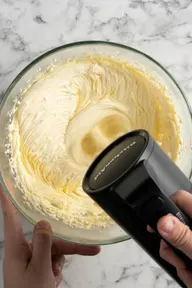
Place 1½ cups softened unsalted butter in a large mixing bowl and beat on medium-high speed for 3 minutes until pale and creamy. Lower the speed and add 5 cups powdered sugar, about one cup at a time.
Pour in ⅓ cup heavy cream or whole milk, 2 teaspoons vanilla extract, and a small pinch of salt. Beat for another 2 to 3 minutes until fluffy. If the frosting feels too stiff, add more cream 1 teaspoon at a time.
Cool the cake layers completely
Leave the cakes in their pans for 10 minutes after baking. This short rest gives the crumb time to set so the layers are less likely to crack when moved.
Run a thin knife around the edges, turn each cake onto a cooling rack, then peel away the parchment paper. Let the layers cool for at least 1 hour, or until no warmth remains in the center. Warm cake can soften buttercream almost instantly, so do not rush this stage.
Heads Up
If the layers still feel even slightly warm, keep cooling them. Frosting warm cake can cause the filling to slide and the outer buttercream to melt.
Beat the vanilla buttercream until smooth
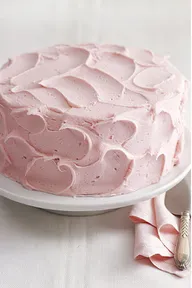
Place 1½ cups softened unsalted butter in a large mixing bowl and beat on medium-high speed for 3 minutes until pale and creamy. Lower the speed and add 5 cups powdered sugar, about one cup at a time.
Pour in ⅓ cup heavy cream or whole milk, 2 teaspoons vanilla extract, and a small pinch of salt. Beat for another 2 to 3 minutes until fluffy. If the frosting feels too stiff, add more cream 1 teaspoon at a time.
Tint part of the frosting pink
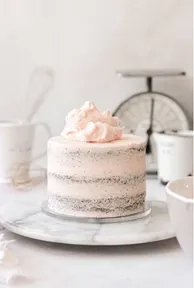
Transfer about one-third of the buttercream to a separate bowl. Add a tiny amount of pink gel food coloring with a clean toothpick, then stir until the color is even.
Start with less coloring than you think you need. Gel color becomes stronger as it spreads through the frosting, and you can always add more. Keep the remaining buttercream white so the cake can have the pink-and-white look that matches classic frosted circus animal cookies.
Level the cooled cake layers
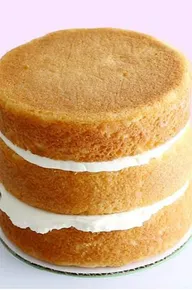
Check each completely cooled layer for a raised dome. If needed, use a long serrated knife or cake leveler to remove only the rounded top, keeping the blade parallel with the counter.
Take off as little cake as possible. You are creating a flat surface, not making the layers thinner. Level tops help the cake sit straight and keep the filling from sliding toward one side. Brush away loose crumbs before you start stacking.
Fill and stack the cake layers
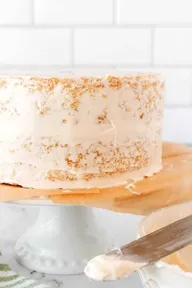
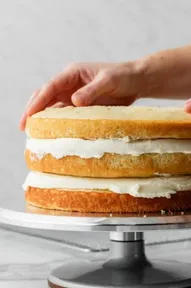
Place the first cake layer cut-side up on a cake board or serving plate. Spread about ¾ cup white buttercream across the top, keeping the layer even from the center to the edge.
Set the second cake layer on top and repeat with another ¾ cup buttercream. Add the final layer with its flattest side facing upward. Look at the cake from several angles and gently adjust the layers until the sides line up.
Do not press down hard. The weight of the cake will settle the filling on its own.
Apply a thin crumb coat
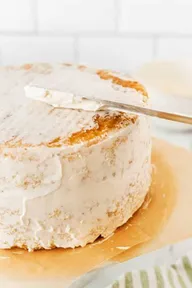
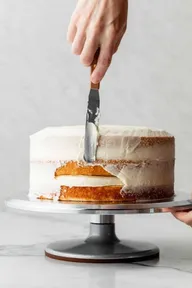
Spread a thin layer of white buttercream over the top and sides of the stacked cake. Use an offset spatula to work the frosting into gaps between the layers and trap loose crumbs against the surface.
You should still be able to see parts of the cake through this coat. A crumb coat is not meant to look finished; it creates a clean base so crumbs do not mix into the final pink-and-white frosting.
Pro Tip
Keep a separate small bowl for frosting that picks up crumbs. This prevents you from carrying cake crumbs back into the clean buttercream you will use for the final coat.
Beat the vanilla buttercream until smooth
Place 1½ cups softened unsalted butter in a large mixing bowl and beat on medium-high speed for 3 minutes until pale and creamy. Lower the speed and add 5 cups powdered sugar, about one cup at a time.
Pour in ⅓ cup heavy cream or whole milk, 2 teaspoons vanilla extract, and a small pinch of salt. Beat for another 2 to 3 minutes until fluffy. If the frosting feels too stiff, add more cream 1 teaspoon at a time.
Tint part of the frosting pink
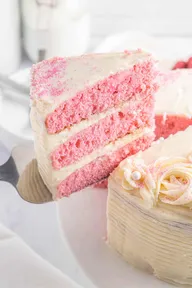
Transfer about one-third of the buttercream to a separate bowl. Add a tiny amount of pink gel food coloring with a clean toothpick, then stir until the color is even.
Start with less coloring than you think you need. Gel color becomes stronger as it spreads through the frosting, and you can always add more. Keep the remaining buttercream white so the cake can have the pink-and-white look that matches classic frosted circus animal cookies. Pasted markdown
Level the cooled cake layers
Check each completely cooled layer for a raised dome. If needed, use a long serrated knife or cake leveler to remove only the rounded top, keeping the blade parallel with the counter.
Take off as little cake as possible. You are creating a flat surface, not making the layers thinner. Level tops help the cake sit straight and keep the filling from sliding toward one side. Brush away loose crumbs before you start stacking.
Fill and stack the cake layers
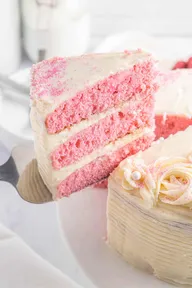
Place the first cake layer cut-side up on a cake board or serving plate. Spread about ¾ cup white buttercream across the top, keeping the layer even from the center to the edge.
Set the second cake layer on top and repeat with another ¾ cup buttercream. Add the final layer with its flattest side facing upward. Look at the cake from several angles and gently adjust the layers until the sides line up.
Do not press down hard. The weight of the cake will settle the filling on its own.
Apply a thin crumb coat
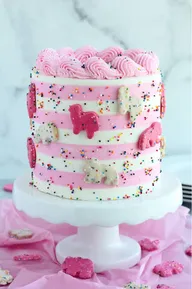
Spread a thin layer of white buttercream over the top and sides of the stacked cake. Use an offset spatula to work the frosting into gaps between the layers and trap loose crumbs against the surface.
You should still be able to see parts of the cake through this coat. A crumb coat is not meant to look finished; it creates a clean base so crumbs do not mix into the final pink-and-white frosting.
Pro Tip
Keep a separate small bowl for frosting that picks up crumbs. This prevents you from carrying cake crumbs back into the clean buttercream you will use for the final coat.
Chill the crumb-coated cake
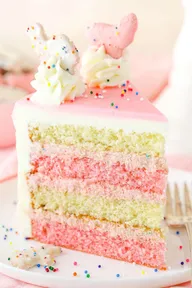
Place the crumb-coated cake in the refrigerator for 20 to 30 minutes. The buttercream should feel firm when lightly touched before you move on.
This short chill locks the crumbs in place and helps the next layer of frosting spread more cleanly. If your kitchen is warm, give the cake the full 30 minutes. Do not freeze it solid; you only want the outside firm enough to support the final coat.
Frost the Frosted Circus Animal Cookie Cake
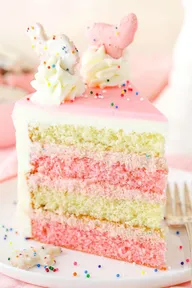
Spread the remaining white buttercream over the top and around parts of the sides, then add the pink buttercream in patches around the cake. Use an offset spatula or cake scraper to blend the edges lightly while keeping both colors visible.
Aim for an even outer coat rather than a perfectly smooth bakery finish. A soft pink-and-white finish fits the playful look of the Frosted Circus Animal Cookie Cake and gives the sprinkles plenty of frosting to grip.
Add sprinkles and circus animal cookies
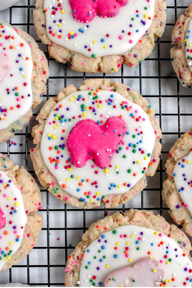
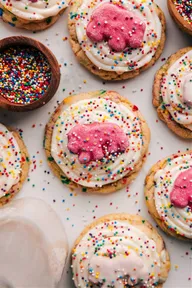
While the frosting is still soft, press rainbow sprinkles gently around the lower sides and scatter a few across the top. Arrange whole frosted circus animal cookies around the top edge or place them in small groups for a fuller look.
Press each cookie only far enough into the buttercream to hold it in place. Save a few cookies to add shortly before serving if you want them to stay extra crisp.
Pro Tip
Add the sprinkles before the frosting crusts over. If they stop sticking, press them onto the surface with very light pressure instead of adding more frosting.
Chill briefly before slicing
Refrigerate the finished cake for 20 to 30 minutes before cutting. This gives the buttercream time to firm up and helps each slice hold its shape instead of leaning or smearing.
For the cleanest cuts, use a long sharp knife and wipe the blade between slices. If the cake has been chilled for several hours, let it sit at room temperature for about 20 minutes before serving so the cake softens and the buttercream becomes creamy again.
Common Mistakes to Avoid
1. Overmixing the batter
Once the flour is added, mix only until the dry streaks disappear. Too much mixing can make the cake firm and heavy instead of soft.
2. Crushing the cookies too finely
Leave some small cookie pieces instead of turning everything into powder. Larger bits give the cake more texture and make the circus-cookie pieces easier to see in each slice.
3. Frosting warm cake layers
Even slightly warm cake can soften the buttercream and make the layers slide. Let every layer cool completely before filling or frosting.
4. Adding too much food coloring
Pink gel coloring is strong. Start with a tiny amount and add more only if needed. Too much can create a darker color than the soft circus-cookie pink you want.
5. Making the filling too thick
A very thick layer of buttercream between cakes can squeeze out when the layers are stacked. About ¾ cup per layer gives enough filling without making the cake unstable.
Frosted Circus Animal Cookie Cake FAQ
Can I make the cake layers ahead of time?
Yes. Bake and cool the layers completely, then wrap each one tightly. Keep them at room temperature for up to 1 day or refrigerate them for up to 2 days before decorating.
Can I use a different brand of frosted animal cookies?
Yes. Any similar pink-and-white frosted animal cookie will work. Choose a crisp cookie rather than a soft one so the pieces hold up better when folded into the batter.
Can I bake this in two cake pans instead of three?
You can use two deeper 8-inch or 9-inch pans, but the layers will need more baking time. Begin checking around 30 minutes and continue until a toothpick comes out without wet batter.
How should I store the finished cake?
Cover the cake and refrigerate it for up to 4 days. For the best texture, let a chilled slice sit at room temperature for about 15 to 20 minutes before eating.
How do I keep the cookies on top from getting soft?
Decorate with most of the cookies as planned, but save a few fresh ones to add right before serving. Cookies sitting against buttercream for several hours will naturally soften a little.
Quick Reference Card
What You Need
- 2½ cups all-purpose flour
- 2½ teaspoons baking powder
- ½ teaspoon fine salt
- ¾ cup unsalted butter
- 1¾ cups granulated sugar
- 4 large eggs
- 1 tablespoon vanilla extract
- 1 cup whole milk
- ½ cup sour cream
- 1½ cups crushed frosted circus animal cookies
- 1½ cups butter for frosting
- 5 cups powdered sugar
- ⅓ cup heavy cream or milk
- 2 teaspoons vanilla
- Pink gel food coloring
- Sprinkles and whole circus animal cookies
Conclusion
Your Frosted Circus Animal Cookie Cake is ready to slice, with soft vanilla layers, bits of frosted cookies, creamy pink-and-white buttercream, and plenty of colorful sprinkles.
Once you make it once, you can easily change the decorating style for birthdays, baby showers, or other celebrations while keeping the same cake base.
Keep the finished cake chilled, then let each slice soften for a few minutes before serving for the best texture.
Save this recipe to Pinterest so you can find it the next time you need a fun celebration cake.
This completes Stage 5 with the recommended Quick Reference Card, short conclusion, and soft Pinterest CTA. Pasted markdown