

The kitchen is still quiet, the coffee has just started brewing, and a tray of croissants from yesterday is sitting on the counter. They are no longer crisp enough to serve as they are, but they are exactly what a warm breakfast bake needs.
An orange Croissant Breakfast turns those slightly dry pastries into a soft, custardy dish with golden edges and a fresh citrus scent. The idea sounds simple, yet a few small choices decide whether the center becomes rich and tender or wet and heavy. Fresh croissants can collapse, too much juice can thin the custard, and tightly packed pieces may stay dry in the corners.
The good news is that none of these problems are hard to fix. The right croissants, finely grated zest, an evenly mixed custard, and a short resting time can change the whole result. The ideas below cover each step, along with useful topping choices, make-ahead tips, baking checks, and serving details. Start with the bread, because that is where the texture begins.
1. Start With Croissants That Can Hold the Custard

Very fresh croissants often turn flat as soon as the custard reaches them. Their soft layers compress, leaving fewer crisp edges on top.
Day-old croissants are a better choice because they have lost some surface moisture but still taste buttery. Tear or cut them into large pieces rather than tiny cubes. Bigger pieces keep their shape and create small pockets where the custard settles without soaking every layer into a paste.
Best choice: use plain, slightly dry croissants with no wet filling. Chocolate or almond croissants can work, but they will make the bake sweeter and may compete with the orange flavor.
<div style="display:flex; flex-wrap:wrap; gap:14px; margin:26px 0; width:100%; max-width:900px; box-sizing:border-box;">
  <div style="flex:1 1 150px; background:#FFF4E8; border:1px solid #E87524; border-radius:12px; padding:18px; text-align:center; box-sizing:border-box;">
    <div style="font-size:30px;">🥐</div>
    <div style="font-size:clamp(18px,3vw,22px); font-weight:800; color:#9A3F12; margin:6px 0 2px;">Fresh</div>
    <div style="font-size:14px; color:#3B2A22; line-height:1.5;">Very soft and more likely to flatten</div>
  </div>
  <div style="flex:1 1 150px; background:#FFF4E8; border:1px solid #E87524; border-radius:12px; padding:18px; text-align:center; box-sizing:border-box;">
    <div style="font-size:30px;">☀️</div>
    <div style="font-size:clamp(18px,3vw,22px); font-weight:800; color:#9A3F12; margin:6px 0 2px;">Day-Old</div>
    <div style="font-size:14px; color:#3B2A22; line-height:1.5;">Sturdy enough to absorb custard evenly</div>
  </div>
  <div style="flex:1 1 150px; background:#FFF4E8; border:1px solid #E87524; border-radius:12px; padding:18px; text-align:center; box-sizing:border-box;">
    <div style="font-size:30px;">🔥</div>
    <div style="font-size:clamp(18px,3vw,22px); font-weight:800; color:#9A3F12; margin:6px 0 2px;">Lightly Toasted</div>
    <div style="font-size:14px; color:#3B2A22; line-height:1.5;">Useful when only fresh croissants are available</div>
  </div>
</div>
2. Gather the Citrus Ingredients Before You Begin

Orange flavor is easiest to control when everything is measured and ready before the custard is mixed. This matters most with zest, since it releases fragrant oils as soon as it is grated.
Set out the croissants, eggs, milk, cream, sugar, vanilla, salt, orange juice, and fresh zest. Use a clean, firm orange with an unwaxed peel when possible. Grate only the bright outer layer and stop before reaching the bitter white pith.
Keep the zest separate until the wet ingredients are ready. That helps preserve its scent instead of leaving it exposed on the counter while the baking dish is prepared.
<div style="background:#FFF4E8; padding:18px 20px; margin:24px 0; width:100%; max-width:900px; border-radius:8px; box-sizing:border-box;">
  <p style="margin:0 0 12px; font-weight:700; color:#9A3F12; font-size:16px;">Gather before mixing</p>
  <div style="display:flex; align-items:flex-start; gap:10px; margin:0 0 9px; box-sizing:border-box;"><span>✅</span><span style="color:#3B2A22; font-size:16px; line-height:1.5;">Plain croissants, preferably one day old</span></div>
  <div style="display:flex; align-items:flex-start; gap:10px; margin:0 0 9px; box-sizing:border-box;"><span>✅</span><span style="color:#3B2A22; font-size:16px; line-height:1.5;">Eggs, milk, cream, sugar, vanilla, and salt</span></div>
  <div style="display:flex; align-items:flex-start; gap:10px; margin:0 0 9px; box-sizing:border-box;"><span>✅</span><span style="color:#3B2A22; font-size:16px; line-height:1.5;">Fresh orange zest and strained orange juice</span></div>
  <div style="display:flex; align-items:flex-start; gap:10px; box-sizing:border-box;"><span>✅</span><span style="color:#3B2A22; font-size:16px; line-height:1.5;">A greased baking dish and a fine grater</span></div>
</div>
3. Use Orange Zest for a Brighter Citrus Flavor
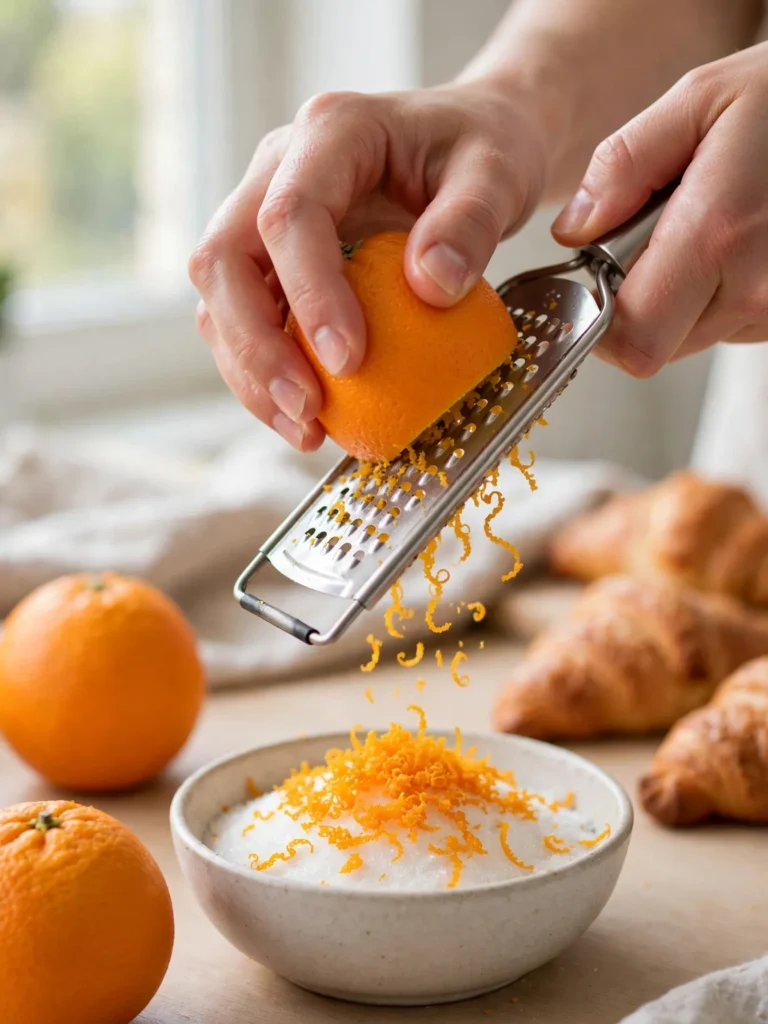
Orange juice adds sweetness and a mild tang, but it does not carry the full scent of the peel. A bake made with juice alone can taste pleasant while still missing the fresh orange note promised by its name.
Finely grated zest fills that gap. Rub it into the sugar with clean fingertips before adding the eggs. This releases the peel’s fragrant oils and spreads them through the custard instead of leaving little clumps in one area.
Start with a modest amount. More zest does not always mean better flavor, especially if white pith slips into the bowl. The finished custard should smell fresh and citrusy, not bitter.
<div style="display:flex; flex-wrap:wrap; gap:14px; margin:26px 0; width:100%; max-width:900px; box-sizing:border-box;">
  <div style="flex:1 1 220px; background:#F3F1EE; border-radius:12px; padding:18px 20px; box-sizing:border-box;">
    <div style="font-weight:800; color:#777777; font-size:13px; letter-spacing:1px; margin-bottom:8px;">JUICE ONLY</div>
    <p style="margin:0; color:#3B2A22; font-size:15px; line-height:1.6;">Adds sweetness and acidity, but the orange scent may stay mild after baking.</p>
  </div>
  <div style="flex:1 1 220px; background:#FFF4E8; border:2px solid #E87524; border-radius:12px; padding:18px 20px; box-sizing:border-box;">
    <div style="font-weight:800; color:#9A3F12; font-size:13px; letter-spacing:1px; margin-bottom:8px;">JUICE AND ZEST 🍊</div>
    <p style="margin:0; color:#3B2A22; font-size:15px; line-height:1.6;">Gives the custard a fuller citrus scent without adding much extra liquid.</p>
  </div>
</div>
4. Choose Between Orange Juice and Orange Marmalade

Orange juice and marmalade do different jobs, so they should not be treated as equal swaps. Juice blends into the custard and gives the whole bake a light citrus taste. Marmalade creates sweeter, stronger pockets of orange.
For an even flavor, whisk strained juice into the custard. For visible ribbons, spoon small amounts of marmalade between the croissant layers. Avoid spreading a thick coat over every piece, since the sugar may make parts of the dish sticky and overly sweet.
A small amount of each also works well. Keep the juice in the custard, then add a few thin marmalade streaks between the upper layers.
<div style="overflow-x:auto; margin:24px 0; width:100%; max-width:900px; box-sizing:border-box;">
  <table style="width:100%; border-collapse:collapse; font-size:15px; color:#3B2A22;">
    <thead>
      <tr>
        <th style="text-align:left; background:#E87524; color:#ffffff; padding:10px 12px; box-sizing:border-box;">Orange Juice</th>
        <th style="text-align:left; background:#9A3F12; color:#ffffff; padding:10px 12px; box-sizing:border-box;">Orange Marmalade</th>
      </tr>
    </thead>
    <tbody>
      <tr>
        <td style="padding:10px 12px; border-bottom:1px solid #E7E7E7; background:#FFF4E8; box-sizing:border-box;">Light flavor throughout the custard</td>
        <td style="padding:10px 12px; border-bottom:1px solid #E7E7E7; box-sizing:border-box;">Stronger orange pockets between layers</td>
      </tr>
      <tr>
        <td style="padding:10px 12px; border-bottom:1px solid #E7E7E7; background:#FFF4E8; box-sizing:border-box;">Adds extra liquid</td>
        <td style="padding:10px 12px; border-bottom:1px solid #E7E7E7; box-sizing:border-box;">Adds extra sweetness and thickness</td>
      </tr>
      <tr>
        <td style="padding:10px 12px; background:#FFF4E8; box-sizing:border-box;">Best for a mild, even citrus taste</td>
        <td style="padding:10px 12px; box-sizing:border-box;">Best for bold, visible orange ribbons</td>
      </tr>
    </tbody>
  </table>
</div>
5. Whisk a Smooth Custard That Soaks In Evenly

A streaky custard can leave some croissant pieces eggy while others taste mostly of milk. The fix is not hard, but the order matters.
Whisk the eggs first until the whites and yolks are fully joined. Add the sugar, zest, vanilla, and salt, then mix in the milk, cream, and orange juice. Pour slowly over the croissants, moving around the dish instead of emptying everything into the center.
Press the top pieces down gently with the back of a spoon. Do not crush them. The aim is to wet the exposed edges while keeping enough structure for a golden, uneven top.
<div style="display:flex; flex-wrap:wrap; gap:0; margin:26px 0; width:100%; max-width:900px; border:1px solid #E87524; border-radius:12px; overflow:hidden; box-sizing:border-box;">
  <div style="flex:1 1 140px; padding:16px; text-align:center; box-sizing:border-box; border-right:1px solid #FFF4E8;">
    <div style="font-size:22px;">🥚</div>
    <div style="font-weight:700; color:#9A3F12; font-size:15px; margin-top:4px;">Whisk</div>
    <div style="color:#3B2A22; font-size:14px; line-height:1.5;">Join the eggs fully before adding dairy</div>
  </div>
  <div style="flex:1 1 140px; padding:16px; text-align:center; box-sizing:border-box; border-right:1px solid #FFF4E8;">
    <div style="font-size:22px;">🥛</div>
    <div style="font-weight:700; color:#9A3F12; font-size:15px; margin-top:4px;">Pour</div>
    <div style="color:#3B2A22; font-size:14px; line-height:1.5;">Move slowly around the whole baking dish</div>
  </div>
  <div style="flex:1 1 140px; padding:16px; text-align:center; box-sizing:border-box;">
    <div style="font-size:22px;">🥄</div>
    <div style="font-weight:700; color:#9A3F12; font-size:15px; margin-top:4px;">Press</div>
    <div style="color:#3B2A22; font-size:14px; line-height:1.5;">Wet dry edges without flattening the layers</div>
  </div>
</div>
6. Add Cream Cheese Without Creating Heavy Clumps

Cream cheese gives the bake a mild tang and makes the center feel richer, but large cold chunks rarely melt evenly. Some bites end up dense while the rest of the dish barely tastes different.
Soften the cream cheese first, then spoon small pieces between the croissant layers. Keep most of them near the middle rather than covering the surface, where they may dry out.
For a smoother result: whisk softened cream cheese with a small splash of milk before adding it. This creates creamy pockets without leaving firm white lumps in the finished bake.
<div style="border-left:5px solid #E87524; background:#FFF4E8; padding:16px 18px; margin:24px 0; width:100%; max-width:900px; border-radius:6px; box-sizing:border-box;">
  <p style="margin:0 0 6px; font-weight:700; color:#9A3F12; font-size:15px;">💡 Quick Tip</p>
  <p style="margin:0; color:#3B2A22; font-size:16px; line-height:1.6;">Let the cream cheese soften at room temperature, then add teaspoon-sized portions between the croissants. Small pieces warm and blend more evenly than large cubes.</p>
</div>
7. Layer the Croissants Instead of Pressing Them Flat

A breakfast bake needs small gaps between the croissant pieces. Those gaps let the custard move through the dish and leave a few flaky ridges exposed on top.
Arrange the lower pieces in a loose layer, then tuck the remaining croissants into the open spaces. Some pieces can stand at a slight angle. Do not push them down as if you are packing a storage box.
A tightly compressed dish may look neat before baking, but the center can become heavy. Loose layers give you a softer base, crisp tips, and more even orange flavor.
<div style="display:flex; flex-wrap:wrap; gap:14px; margin:26px 0; width:100%; max-width:900px; box-sizing:border-box;">
  <div style="flex:1 1 220px; background:#FFF4E8; border-radius:12px; padding:18px 20px; box-sizing:border-box;">
    <div style="font-weight:800; color:#9A3F12; font-size:15px; margin-bottom:10px;">✅ Do this</div>
    <p style="margin:0 0 6px; color:#3B2A22; font-size:15px; line-height:1.55;">Leave small gaps for the custard to flow through.</p>
    <p style="margin:0; color:#3B2A22; font-size:15px; line-height:1.55;">Keep a few torn edges raised above the liquid.</p>
  </div>
  <div style="flex:1 1 220px; background:#F6EFEE; border-radius:12px; padding:18px 20px; box-sizing:border-box;">
    <div style="font-weight:800; color:#9A4A3F; font-size:15px; margin-bottom:10px;">🚫 Skip this</div>
    <p style="margin:0 0 6px; color:#3B2A22; font-size:15px; line-height:1.55;">Do not crush the croissants into a solid layer.</p>
    <p style="margin:0; color:#3B2A22; font-size:15px; line-height:1.55;">Do not hide every flaky edge below the custard.</p>
  </div>
</div>
8. Let the Bake Rest Before It Goes Into the Oven

The custard needs time to move into the thicker parts of each croissant. Baking the dish right after pouring may leave dry centers beside wet patches.
Let the filled dish rest until the exposed pieces feel damp but still hold their shape. During this time, press down any pale corners that have not touched the liquid.
Watch the surface: the croissants should look evenly moistened, not completely submerged. A short rest gives the center a tender texture while helping the raised edges stay golden during baking.
<div style="margin:24px 0; width:100%; max-width:900px; box-sizing:border-box;">
  <div style="display:flex; align-items:flex-start; gap:12px; margin:0 0 14px; box-sizing:border-box;">
    <span style="flex:0 0 auto; width:30px; height:30px; background:#E87524; color:#ffffff; border-radius:50%; display:flex; align-items:center; justify-content:center; font-weight:700; font-size:15px;">1</span>
    <p style="margin:0; color:#3B2A22; font-size:16px; line-height:1.6;">Pour the custard slowly across the entire dish.</p>
  </div>
  <div style="display:flex; align-items:flex-start; gap:12px; margin:0 0 14px; box-sizing:border-box;">
    <span style="flex:0 0 auto; width:30px; height:30px; background:#E87524; color:#ffffff; border-radius:50%; display:flex; align-items:center; justify-content:center; font-weight:700; font-size:15px;">2</span>
    <p style="margin:0; color:#3B2A22; font-size:16px; line-height:1.6;">Press dry corners gently into the liquid without flattening them.</p>
  </div>
  <div style="display:flex; align-items:flex-start; gap:12px; box-sizing:border-box;">
    <span style="flex:0 0 auto; width:30px; height:30px; background:#E87524; color:#ffffff; border-radius:50%; display:flex; align-items:center; justify-content:center; font-weight:700; font-size:15px;">3</span>
    <p style="margin:0; color:#3B2A22; font-size:16px; line-height:1.6;">Rest until the thicker pieces have absorbed some custard.</p>
  </div>
</div>
9. Prepare It the Night Before for an Easier Morning

Overnight preparation works well when breakfast needs to reach the table without much early mixing. Assemble the croissants and custard, cover the dish, and place it in the refrigerator.
Keep crunchy toppings off until morning. Almonds and coarse sugar can soften if they sit on wet croissants for several hours.
Before baking, check the top for dry pieces and spoon a little pooled custard over them. Let a cold glass or ceramic dish lose some of its chill while the oven heats. Always follow the temperature guidance provided by the dish manufacturer.
<div style="background:#E87524; border-radius:12px; padding:22px 24px; margin:26px 0; width:100%; max-width:900px; box-sizing:border-box;">
  <div style="font-size:13px; letter-spacing:1px; color:#ffffff; opacity:0.85; font-weight:700; margin-bottom:6px;">THE MAKE-AHEAD RULE</div>
  <p style="margin:0; color:#ffffff; font-size:clamp(16px,2.6vw,19px); line-height:1.55; font-weight:600;">Refrigerate the croissant and custard base overnight, then add nuts, coarse sugar, and other crisp toppings just before baking.</p>
</div>
10. Add Berries for Fresh Color and Gentle Tartness

Berries break up the rich custard with small bursts of tart flavor. They also look bright against the golden croissants and pale orange filling.
Fresh blueberries and raspberries can be scattered between the layers with little preparation. Slice large strawberries so they do not release moisture in one heavy spot. Frozen berries may also work, but thawing them first can leave extra liquid in the dish.
Use berries as an accent rather than filling every gap. Too many can cool the center, thin the custard, and hide the orange flavor.
<ul style="margin:20px 0; padding-left:0; width:100%; max-width:900px; list-style:none; color:#3B2A22; font-size:16px; line-height:1.6; box-sizing:border-box;">
  <li style="margin:0 0 8px; padding-left:24px; position:relative; box-sizing:border-box;"><span style="position:absolute; left:0; color:#E87524;">▸</span><strong style="color:#9A3F12;">Blueberries:</strong> mild, neat, and easy to spread evenly</li>
  <li style="margin:0 0 8px; padding-left:24px; position:relative; box-sizing:border-box;"><span style="position:absolute; left:0; color:#E87524;">▸</span><strong style="color:#9A3F12;">Raspberries:</strong> softer with a sharper tart note</li>
  <li style="margin:0 0 8px; padding-left:24px; position:relative; box-sizing:border-box;"><span style="position:absolute; left:0; color:#E87524;">▸</span><strong style="color:#9A3F12;">Strawberries:</strong> best sliced into small, even pieces</li>
  <li style="padding-left:24px; position:relative; box-sizing:border-box;"><span style="position:absolute; left:0; color:#E87524;">▸</span><strong style="color:#9A3F12;">Cranberries:</strong> more tart, so use a lighter hand</li>
</ul>
11. Create a Crisp Top With Almonds and Coarse Sugar

The top should have some contrast with the soft custard below. A small amount of sliced almonds or coarse sugar adds texture without covering the orange flavor.
Scatter the topping just before baking, especially when the dish has rested overnight. Almonds placed on wet croissants too early may soften, while regular fine sugar can disappear into the custard.
Keep it balanced: use almonds for a toasted crunch, coarse sugar for a light crackle, or a small amount of both. Leave a few croissant ridges uncovered so their buttery layers can brown on their own.
<div style="display:flex; flex-wrap:wrap; gap:14px; margin:26px 0; width:100%; max-width:900px; box-sizing:border-box;">
  <div style="flex:1 1 150px; background:#FFF4E8; border:1px solid #E87524; border-radius:12px; padding:18px; text-align:center; box-sizing:border-box;">
    <div style="font-size:30px;">🌰</div>
    <div style="font-size:clamp(18px,3vw,22px); font-weight:800; color:#9A3F12; margin:6px 0 2px;">Sliced Almonds</div>
    <div style="font-size:14px; color:#3B2A22; line-height:1.5;">Adds a toasted, nutty crunch</div>
  </div>
  <div style="flex:1 1 150px; background:#FFF4E8; border:1px solid #E87524; border-radius:12px; padding:18px; text-align:center; box-sizing:border-box;">
    <div style="font-size:30px;">✨</div>
    <div style="font-size:clamp(18px,3vw,22px); font-weight:800; color:#9A3F12; margin:6px 0 2px;">Coarse Sugar</div>
    <div style="font-size:14px; color:#3B2A22; line-height:1.5;">Creates a thin, crisp surface</div>
  </div>
  <div style="flex:1 1 150px; background:#FFF4E8; border:1px solid #E87524; border-radius:12px; padding:18px; text-align:center; box-sizing:border-box;">
    <div style="font-size:30px;">🥐</div>
    <div style="font-size:clamp(18px,3vw,22px); font-weight:800; color:#9A3F12; margin:6px 0 2px;">Plain Ridges</div>
    <div style="font-size:14px; color:#3B2A22; line-height:1.5;">Lets the buttery layers brown naturally</div>
  </div>
</div>
12. Bake Covered First, Then Uncover for Browning
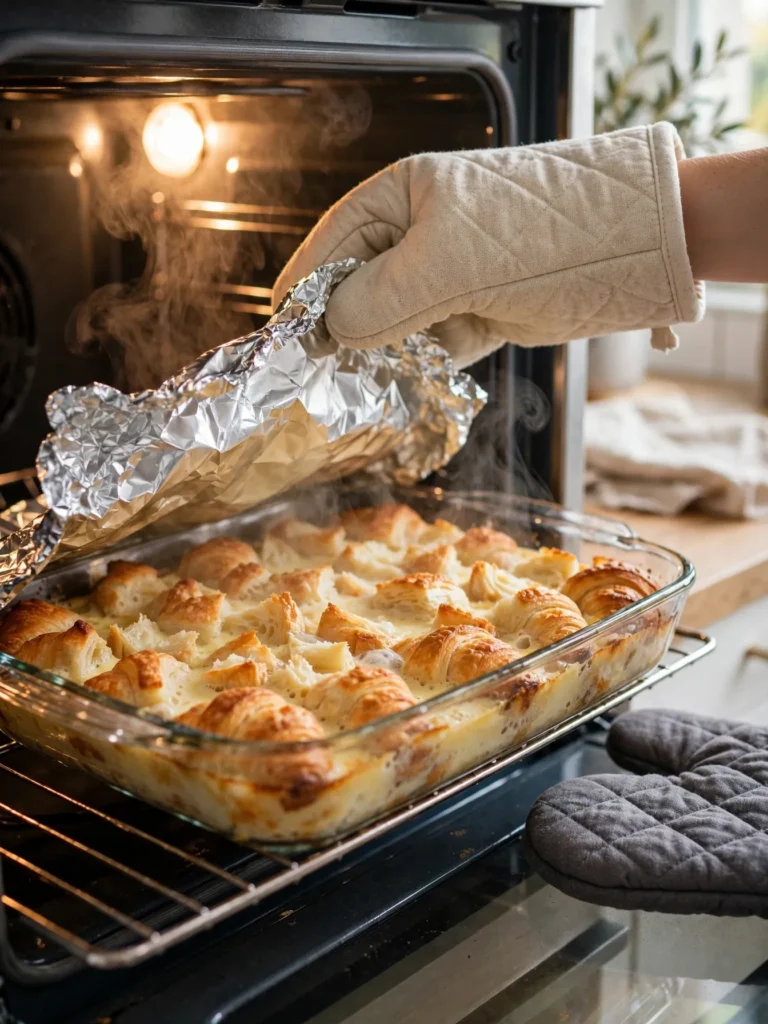
The center and the top do not cook at the same speed. Exposed croissant tips can darken before the custard beneath them has fully set.
Cover the dish loosely during the first part of baking. This holds in gentle heat and protects the raised edges. Remove the cover later so the surface can turn golden and the toppings can crisp.
Check the bake rather than relying only on the clock. Oven strength, dish depth, and starting temperature can all affect the timing. If one corner browns quickly, cover only that area with a small piece of foil.
<div style="background:#FFF4E8; padding:18px 20px; margin:24px 0; width:100%; max-width:900px; border-radius:8px; box-sizing:border-box;">
  <p style="margin:0 0 12px; font-weight:700; color:#9A3F12; font-size:16px;">Baking check</p>
  <div style="display:flex; align-items:flex-start; gap:10px; margin:0 0 9px; box-sizing:border-box;">
    <span>✅</span>
    <span style="color:#3B2A22; font-size:16px; line-height:1.5;">Cover loosely at the start to protect the croissant tips.</span>
  </div>
  <div style="display:flex; align-items:flex-start; gap:10px; margin:0 0 9px; box-sizing:border-box;">
    <span>✅</span>
    <span style="color:#3B2A22; font-size:16px; line-height:1.5;">Uncover once the center has started to firm.</span>
  </div>
  <div style="display:flex; align-items:flex-start; gap:10px; margin:0 0 9px; box-sizing:border-box;">
    <span>✅</span>
    <span style="color:#3B2A22; font-size:16px; line-height:1.5;">Watch thin edges and almonds during the final browning stage.</span>
  </div>
  <div style="display:flex; align-items:flex-start; gap:10px; box-sizing:border-box;">
    <span>✅</span>
    <span style="color:#3B2A22; font-size:16px; line-height:1.5;">Shield one dark corner instead of covering the whole dish again.</span>
  </div>
</div>
13. Test the Center Without Drying Out the Edges
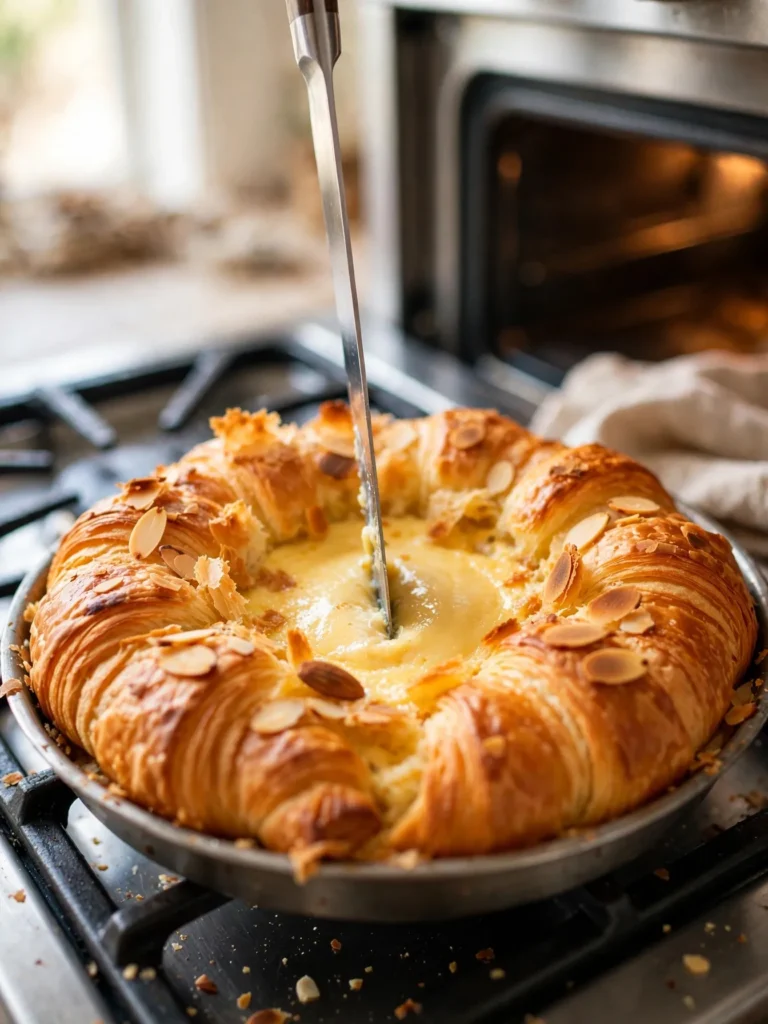
A browned top does not always mean the middle is ready. The center should look set around the croissant pieces, with no thin liquid moving across the surface.
Give the dish a gentle shake. A slight soft movement in the middle is fine, but a loose wave of custard means it needs more time. You can also insert a thin knife near the center. It should come out moist, not coated in raw egg mixture.
Remove the bake before the edges become firm and dry. The center will continue settling as the dish rests on the counter.
<div style="display:flex; flex-wrap:wrap; gap:14px; margin:26px 0; width:100%; max-width:900px; box-sizing:border-box;">
  <div style="flex:1 1 220px; background:#F3F1EE; border-radius:12px; padding:18px 20px; box-sizing:border-box;">
    <div style="font-weight:800; color:#777777; font-size:13px; letter-spacing:1px; margin-bottom:8px;">NEEDS MORE TIME</div>
    <p style="margin:0; color:#3B2A22; font-size:15px; line-height:1.6;">The center moves like liquid, pale custard pools between pieces, and the knife carries wet egg mixture.</p>
  </div>
  <div style="flex:1 1 220px; background:#FFF4E8; border:2px solid #E87524; border-radius:12px; padding:18px 20px; box-sizing:border-box;">
    <div style="font-weight:800; color:#9A3F12; font-size:13px; letter-spacing:1px; margin-bottom:8px;">READY TO REST 🍊</div>
    <p style="margin:0; color:#3B2A22; font-size:15px; line-height:1.6;">The middle has a gentle softness, no loose liquid is visible, and the top is evenly golden.</p>
  </div>
</div>
14. Finish With a Light Orange Glaze After Baking

A glaze should brighten the orange flavor, not soak the crisp top. Wait until the bake has rested and the strongest oven heat has faded before adding it.
Mix a small amount of orange juice into powdered sugar until it falls from the spoon in a thin ribbon. Drizzle it across the raised croissant pieces instead of pouring it over the whole dish.
For less sweetness, skip the full glaze and dust the top lightly with powdered sugar. Fresh zest can be added at the end for extra fragrance, but keep the strands fine so no bite tastes bitter.
<div style="border-left:5px solid #E87524; background:#FFF4E8; padding:16px 18px; margin:24px 0; width:100%; max-width:900px; border-radius:6px; box-sizing:border-box;">
  <p style="margin:0 0 6px; font-weight:700; color:#9A3F12; font-size:15px;">📌 Good To Know</p>
  <p style="margin:0; color:#3B2A22; font-size:16px; line-height:1.6;">Drizzle the glaze after the bake has cooled slightly. A very hot surface melts the glaze quickly and can make the croissant ridges wet instead of lightly coated.</p>
</div>
15. Serve and Reheat the Croissant Breakfast the Right Way

This Croissant Breakfast is easiest to slice after it has rested for a few minutes. The custard settles, the orange scent becomes clearer, and the pieces hold together better on the plate.
Serve it warm with fresh berries, plain yogurt, or orange slices. Heavy syrup is usually unnecessary because the croissants, custard, and glaze already bring sweetness.
Store leftovers covered in the refrigerator. Reheat individual portions gently so the center warms without turning the edges hard. The oven helps restore more surface texture, while the microwave is quicker but leaves the top softer.
<div style="display:flex; flex-wrap:wrap; gap:0; margin:26px 0; width:100%; max-width:900px; border:1px solid #E87524; border-radius:12px; overflow:hidden; box-sizing:border-box;">
 <div style="flex:1 1 140px; padding:16px; text-align:center; box-sizing:border-box; border-right:1px solid #FFF4E8;">
 <div style="font-size:22px;">🍽️</div>
 <div style="font-weight:700; color:#9A3F12; font-size:15px; margin-top:4px;">Serve</div>
 <div style="color:#3B2A22; font-size:14px; line-height:1.5;">Warm after a short resting period</div>
 </div>
 <div style="flex:1 1 140px; padding:16px; text-align:center; box-sizing:border-box; border-right:1px solid #FFF4E8;">
 <div style="font-size:22px;">🧊</div>
 <div style="font-weight:700; color:#9A3F12; font-size:15px; margin-top:4px;">Store</div>
 <div style="color:#3B2A22; font-size:14px; line-height:1.5;">Covered in the refrigerator</div>
 </div>
 <div style="flex:1 1 140px; padding:16px; text-align:center; box-sizing:border-box;">
 <div style="font-size:22px;">🔥</div>
 <div style="font-weight:700; color:#9A3F12; font-size:15px; margin-top:4px;">Reheat</div>
 <div style="color:#3B2A22; font-size:14px; line-height:1.5;">Gently, until the center is warm</div>
 </div>
</div>
Conclusion
A good orange croissant breakfast bake should feel soft in the middle, lightly crisp on top, and fresh rather than overly sweet. Day-old croissants, orange zest, a smooth custard, and a short resting time do most of the work. The toppings and fillings can change with the season, but the basic method stays simple.
Serve it for a slow weekend breakfast, a family brunch, or a holiday morning when you want something warm without standing at the stove. Keep this recipe nearby the next time a bag of croissants starts to lose its crispness.
Save this Croissant Breakfast idea to your Pinterest breakfast board for your next brunch or make-ahead morning.