
A vanilla cake can look perfect on the outside and still turn out dry, heavy, or crumbly once you cut the first slice. A good Moist Vanilla Layer Cake needs more than extra frosting to stay soft. The batter needs the right balance of butter, milk, sour cream, and air, and those ingredients need to go into the bowl in the right order.
This recipe makes two 8-inch cake layers with a soft, fine crumb and a clear vanilla flavor. Sour cream adds moisture without making the batter runny, while creaming the butter and sugar builds tiny air pockets that help the layers rise. Room-temperature eggs and dairy keep the batter smooth instead of curdled.
Plan on about 35 minutes of active work, plus baking and cooling time. The method is beginner-friendly, but do not rush the mixing or cooling stages. Those are the spots where a good vanilla cake can quickly become dense or break apart.
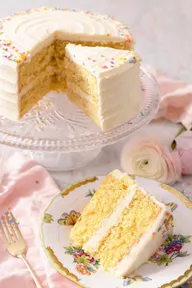
By the end, you will have level vanilla cake layers ready to stack with smooth vanilla buttercream.
What You Need
For the Vanilla Cake
- 2½ cups (300 g) all-purpose flour
- 2½ teaspoons baking powder
- ½ teaspoon fine salt
- ¾ cup (170 g) unsalted butter, softened
- 1¾ cups (350 g) granulated sugar
- 4 large eggs, room temperature
- 1 tablespoon pure vanilla extract
- 1 cup (240 ml) whole milk, room temperature
- ½ cup (120 g) full-fat sour cream, room temperature
For the Vanilla Buttercream
- 1½ cups (340 g) unsalted butter, softened
- 5 cups (600 g) powdered sugar
- 2 teaspoons pure vanilla extract
- 3–5 tablespoons heavy cream or whole milk
- ¼ teaspoon fine salt
Tools
- Two 8-inch round cake pans
- Parchment paper
- Large mixing bowl
- Medium mixing bowl
- Electric hand mixer or stand mixer
- Whisk
- Rubber spatula
- Cooling rack
- Serrated knife or cake leveler
- Offset spatula
At a Glance
- Bring the ingredients to room temperature.
- Prepare the cake pans for clean release.
- Whisk the dry ingredients evenly.
- Cream the butter and sugar until pale and fluffy.
- Beat in the eggs one at a time.
- Blend in the vanilla extract.
- Combine the milk and sour cream.
- Fold the dry and wet mixtures into the batter.
- Divide the batter evenly between the pans.
- Bake the vanilla cake layers until set.
- Cool the cake layers completely.
- Beat the vanilla buttercream until smooth.
- Level the cooled cake layers.
- Stack the cake with even buttercream layers.
- Apply a thin crumb coat.
- Chill the crumb-coated cake until firm.
- Frost the Moist Vanilla Layer Cake smoothly.
- Slice the cake with clean cuts.
Bring the ingredients to room temperature
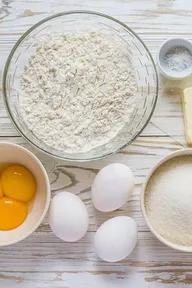
Take the butter, eggs, milk, and sour cream out of the refrigerator about 45–60 minutes before mixing. The butter should feel soft when pressed but should not look melted or greasy. Room-temperature ingredients blend together more evenly, which helps prevent a lumpy or curdled batter.
If you forgot to take the eggs out early, place them in a bowl of warm—not hot—water for about 10 minutes.
Prepare the cake pans for clean release
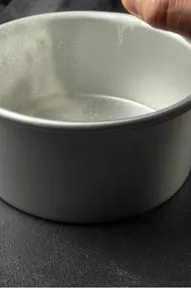
Heat the oven to 350°F (175°C). Lightly grease two 8-inch round cake pans, place a parchment-paper circle in the bottom of each pan, then grease the parchment.
Pay extra attention to the corners where the bottom meets the sides. Cake tends to stick there first. The parchment protects the soft bottom crumb when you turn the layers out after baking, so do not rely on grease alone.
Whisk the dry ingredients evenly
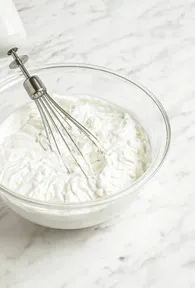
Place 2½ cups (300 g) all-purpose flour, 2½ teaspoons baking powder, and ½ teaspoon salt in a medium bowl. Whisk for about 20–30 seconds, moving around the full bowl instead of stirring only in the center.
This spreads the baking powder through the flour before it reaches the wet batter. Uneven baking powder can leave one area of a cake layer tall and airy while another stays heavy. Break apart any visible flour lumps with the whisk.
Cream the butter and sugar until pale and fluffy
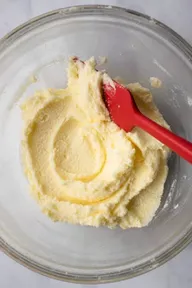
The mixture should change in both color and texture as you beat it. Add ¾ cup (170 g) softened unsalted butter and 1¾ cups (350 g) granulated sugar to a large mixing bowl, then beat on medium-high speed for 3–4 minutes.
Stop when the butter looks pale, airy, and slightly increased in volume. Scrape down the bowl once halfway through so no dense butter stays around the bottom or sides. This trapped air helps the cake layers rise with a softer crumb.
If the butter looks shiny or starts melting around the bowl, stop mixing and let it cool for a few minutes. Butter that is too warm cannot hold as much air.
Beat in the eggs one at a time
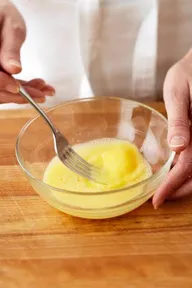
Use 4 large room-temperature eggs, adding only one before beating on medium speed for about 20–30 seconds. Wait until most of that egg disappears into the butter mixture before adding the next.
Scrape the sides and bottom of the bowl after the second egg and again after the fourth. The batter may look slightly uneven for a moment, but it should come back together. Adding cold eggs too quickly can make the butter firm up and leave the mixture visibly curdled.
Blend in the vanilla extract
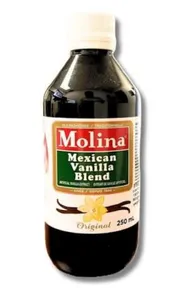
A full 1 tablespoon of pure vanilla extract gives these layers a clear vanilla flavor instead of leaving the cake tasting mostly sweet. Pour it into the egg-and-butter mixture and beat on low speed for about 15 seconds, only until the color looks even.
Scrape the bowl once more with a rubber spatula. This makes sure the vanilla and any mixture caught around the edges are evenly distributed before the dairy and flour go in.
Combine the milk and sour cream
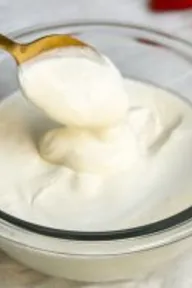
Whisk 1 cup (240 ml) room-temperature whole milk with ½ cup (120 g) full-fat sour cream in a small bowl until the mixture looks smooth and even.
Sour cream is thicker than milk, so spend about 20 seconds breaking up any small pockets before moving on. Combining the dairy first makes it easier to add evenly to the batter later and helps keep the finished cake soft without making the crumb wet or heavy.
Fold the dry and wet mixtures into the batter
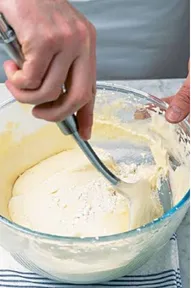
Add about one-third of the dry ingredients to the butter mixture and mix on low speed until most of the flour disappears. Add half of the milk mixture, followed by another third of the dry ingredients, the remaining milk mixture, and the final dry portion.
Stop the mixer as soon as you no longer see dry flour. Finish with a rubber spatula, folding from the bottom of the bowl a few times.
Do not keep beating once the flour is mixed in. Too much mixing develops the flour’s gluten and can turn soft vanilla layers firm, chewy, or dense.
Divide the batter evenly between the pans
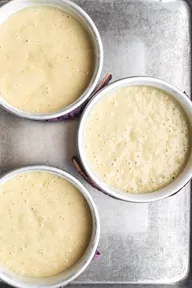
Set both prepared pans beside the mixing bowl and spoon the batter between them as evenly as you can. For the most even layers, place each pan on a kitchen scale and aim for the same batter weight in both.
Smooth the tops gently with a spatula without pressing the batter down. Give each pan one or two light taps on the counter to release large trapped air pockets. Both pans should now have an even layer of batter ready for the oven.
Bake the vanilla cake layers until set
Place both pans on the center oven rack with a little space between them so hot air can move around each pan. Bake at 350°F (175°C) for 28–34 minutes.
Start checking near the 28-minute mark. The tops should look lightly golden, the centers should spring back when touched gently, and a toothpick pushed into the middle should come out clean or with a few soft crumbs.
A completely dry toothpick is not the goal if the cake has already been baking near the upper end of the time range. Leaving the layers in too long can dry the edges and reduce the soft texture you worked to build.
Cool the cake layers completely
Leave the baked cakes in their pans for 10–15 minutes. This short rest lets the soft crumb firm enough to handle without trapping too much heat inside the pans.
Run a thin knife around the edges if needed, turn each layer onto a cooling rack, and peel away the parchment. Leave the cakes undisturbed until they reach room temperature, usually another 45–60 minutes. Frosting warm cake will soften the buttercream and can make the layers slide.
Beat the vanilla buttercream until smooth
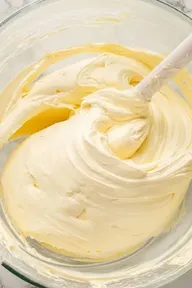
Start with 1½ cups (340 g) softened unsalted butter and beat it on medium-high speed for 3 minutes until creamy and lighter in texture. Lower the mixer speed and gradually add 5 cups (600 g) powdered sugar so it does not scatter out of the bowl.
Beat in 2 teaspoons vanilla extract, ¼ teaspoon salt, and 3 tablespoons heavy cream or whole milk. Continue mixing for 2–3 minutes. If the frosting feels too stiff to spread, beat in the remaining cream 1 tablespoon at a time until smooth and fluffy.
Set each completely cooled cake on a flat surface and check the top from eye level. If either layer has a raised dome, use a long serrated knife or cake leveler to trim it until the surface is flat.
Work slowly and keep the blade parallel with the counter. Removing only the highest part gives the cake a stable base without wasting too much crumb. Save the trimmed pieces for snacking or cake crumbs.
Stack the cake with even buttercream layers
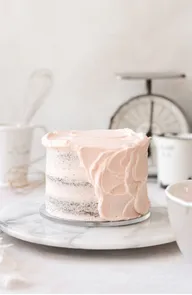
Place the first cake layer cut-side up on a cake board or serving plate. Spread about ¾ to 1 cup of vanilla buttercream across the top, taking it close to the edge in an even layer.
Set the second cake layer on top with the flatter side facing upward. Look at the cake from several angles and gently adjust the top layer until the sides line up. An even stack now makes the final frosting much easier to smoot
If the cake slides while you stack it, place a small dab of buttercream under the bottom layer to help hold it to the plate or cake board.
Apply a thin crumb coat
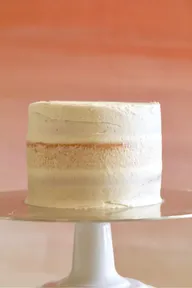
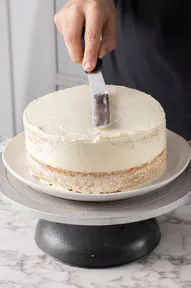
Spread a thin layer of buttercream over the top and sides of the stacked cake. Use enough frosting to trap loose crumbs, but keep this coat much thinner than the final layer.
An offset spatula works well for the top, while a bench scraper can help tidy the sides. Do not worry if cake shows through in places. The goal is to seal the crumbs so they do not mix into the smooth outer frosting later.
Chill the crumb-coated cake until firm
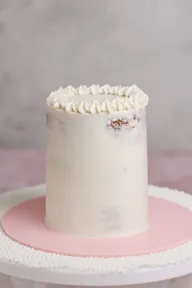
Place the crumb-coated cake in the refrigerator for 20–30 minutes. The buttercream should feel firm when lightly touched and should no longer stick to your fingertip.
This short chill locks loose crumbs in place and gives the final frosting a stable surface to sit on. Do not leave the cake uncovered in the refrigerator for several hours, because the exposed cake can begin to dry around the edges.
Frost the Moist Vanilla Layer Cake smoothly
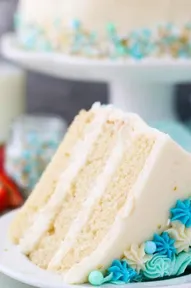
Add a generous layer of buttercream to the top of the chilled cake, then spread more around the sides. Use an offset spatula to move the frosting and a bench scraper to smooth the outer surface.
Work with light pressure and remove excess frosting as you go. If the buttercream starts to drag or tear the surface, warm the scraper under hot water, dry it well, and pass it lightly around the cake again. Aim for an even finish rather than pressing hard enough to expose the crumb coat.
Smooth the sides before finishing the top edge. Pull the small ridge of frosting at the top inward with an offset spatula for a cleaner finish.
Slice the cake with clean cuts
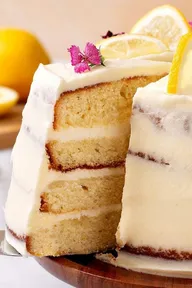
Let the finished cake sit at room temperature for about 20–30 minutes if it was chilled before serving. The buttercream will soften slightly, and the cake will taste more tender.
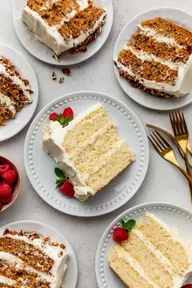
Use a long, sharp knife for each slice. Dip the blade in hot water, wipe it completely dry, then cut straight down through the layers. Clean the knife between slices so buttercream and crumbs do not drag across the next piece.
Troubleshooting Guide
| If This Happens | Try This |
|---|---|
| The cake feels dry | Check the cake near the 28-minute mark and remove it once a toothpick has only a few soft crumbs. Measure the flour by weight when possible, since too much flour can also dry the crumb. |
| The layers are dense or heavy | Cream the butter and sugar for the full 3–4 minutes, and stop mixing once the last streaks of flour disappear. Overmixed batter can lose the soft texture you want. |
| The middle sinks | Avoid opening the oven during the early part of baking. Make sure the center springs back lightly and the cake is fully set before removing the pans. |
| The layers rise unevenly | Whisk the dry ingredients thoroughly and divide the batter evenly between both pans. A kitchen scale gives the most even result. |
| The batter looks curdled | Use room-temperature eggs and add them one at a time. Cold eggs can cause softened butter to firm up and separate from the mixture. |
| The buttercream is too stiff | Beat in heavy cream or milk 1 tablespoon at a time until the frosting spreads smoothly without running. |
| The frosting pulls up crumbs | Make sure the cake is fully cool, apply a thin crumb coat, and chill it for 20–30 minutes before adding the final frosting. |
Moist Vanilla Layer Cake FAQ
Why should the ingredients be at room temperature?
Room-temperature butter, eggs, milk, and sour cream blend together more evenly. This helps the batter stay smooth and gives the cake a finer, softer crumb.
Can I use cake flour instead of all-purpose flour?
Yes, but the texture may be slightly softer and more delicate. For the recipe as written, all-purpose flour gives the layers enough structure for stacking and frosting.
Can I make the cake layers ahead of time?
Yes. Cool them completely, wrap each layer tightly, and keep them at room temperature for up to 1 day. For longer storage, refrigerate or freeze them.
Can I freeze the vanilla cake layers?
Yes. Wrap the cooled layers well and freeze them for up to 2 months. Thaw them while still wrapped so condensation forms on the wrapping instead of the cake surface.
Why did my cake turn out dense?
The butter and sugar may not have been creamed long enough, or the batter may have been mixed too much after the flour was added. Both can reduce the light texture.
Should I refrigerate the finished cake?
For longer storage, keep it covered in the refrigerator. Let refrigerated slices sit at room temperature for about 20–30 minutes before serving so the cake and buttercream soften again.
Moist Vanilla Layer Cake Quick Reference
Cake Ingredients
- 2½ cups (300 g) all-purpose flour
- 2½ teaspoons baking powder
- ½ teaspoon fine salt
- ¾ cup (170 g) unsalted butter
- 1¾ cups (350 g) granulated sugar
- 4 large eggs
- 1 tablespoon vanilla extract
- 1 cup (240 ml) whole milk
- ½ cup (120 g) full-fat sour cream
Buttercream
- 1½ cups (340 g) unsalted butter
- 5 cups (600 g) powdered sugar
- 2 teaspoons vanilla extract
- 3–5 tablespoons heavy cream or whole milk
- ¼ teaspoon fine salt
Key Numbers
Pan size: Two 8-inch round pans
Oven: 350°F (175°C)
Bake time: 28–34 minutes
Pan cooling: 10–15 minutes
Full cooling: 45–60 minutes
Crumb-coat chill: 20–30 minutes
Steps at a Glance
- Bring the ingredients to room temperature.
- Prepare two 8-inch cake pans.
- Whisk the dry ingredients.
- Cream the butter and sugar.
- Beat in the eggs one at a time.
- Blend in the vanilla.
- Combine the milk and sour cream.
- Fold the wet and dry mixtures together.
- Divide the batter evenly.
- Bake until the centers are set.
- Cool the cake layers completely.
- Beat the vanilla buttercream.
- Level the cake layers.
- Stack with an even buttercream layer.
- Apply a thin crumb coat.
- Chill until the crumb coat is firm.
- Cover with the final frosting.
- Slice with a clean, warm knife.
CONCLUSION
You now have a Moist Vanilla Layer Cake with soft layers, a tender crumb, and smooth vanilla buttercream.
The biggest difference comes from the small details: room-temperature ingredients, properly creamed butter, gentle mixing after the flour goes in, and enough cooling time before frosting.
Serve it at room temperature for the softest texture. Once you are comfortable with the base recipe, you can use the same layers with fruit filling, chocolate frosting, or other simple cake fillings.
Save this recipe to Pinterest so you have the measurements, baking time, and frosting steps ready the next time you need a dependable vanilla layer cake.